If you've been exploring options for your next web project, you've probably come across both React and Next.js. And if you're not a developer, the difference between the two can feel confusing — especially when people throw around terms like "server-side rendering" and "static site generation" like everyone knows what they mean.
Let's cut through the jargon. By the end of this post, you'll know exactly which one makes sense for your project and why.
First, What's the Difference?
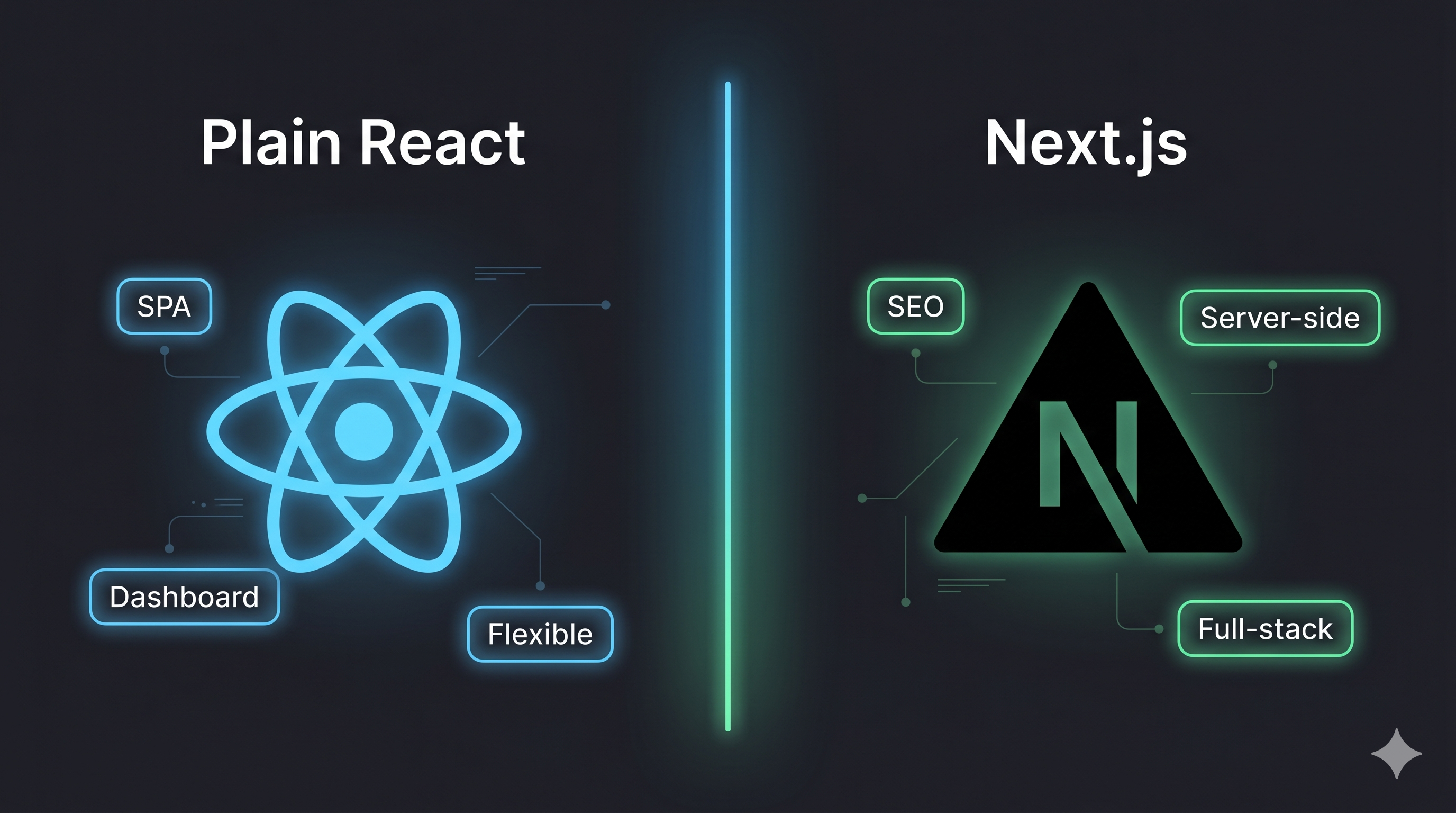
React is a JavaScript library for building user interfaces. At its core, it's just a tool for creating interactive UI components — buttons, forms, menus, dynamic content. React doesn't come with routing, data fetching, or any server-side capabilities out of the box. You're essentially building on a blank canvas.
Next.js is a framework built on top of React. It takes React and adds a full set of features: file-based routing, server-side rendering, static site generation, API routes, image optimization, and more. Think of React as the engine and Next.js as the car around it.
So the question isn't really "React or Next.js" — it's "plain React or React with Next.js."
When Plain React Makes Sense
Plain React (often set up with Vite or Create React App) is a great fit when:
You're building a Single Page Application (SPA) — Think dashboards, internal tools, or admin panels where the content is behind a login and SEO doesn't matter. Since these apps load once and then update dynamically, server-side rendering isn't needed.
You need maximum flexibility — React without a framework gives you total control. You pick your own router, your own data fetching solution, your own everything. For experienced teams who know exactly what they want, this can be a feature, not a bug.
You're prototyping quickly — If you just need to get an idea in front of people fast, plain React with Vite is fast to set up and easy to iterate on.
You're building a React Native mobile app — If your primary target is iOS and Android using React Native, plain React logic is at the core. Next.js is web-only.
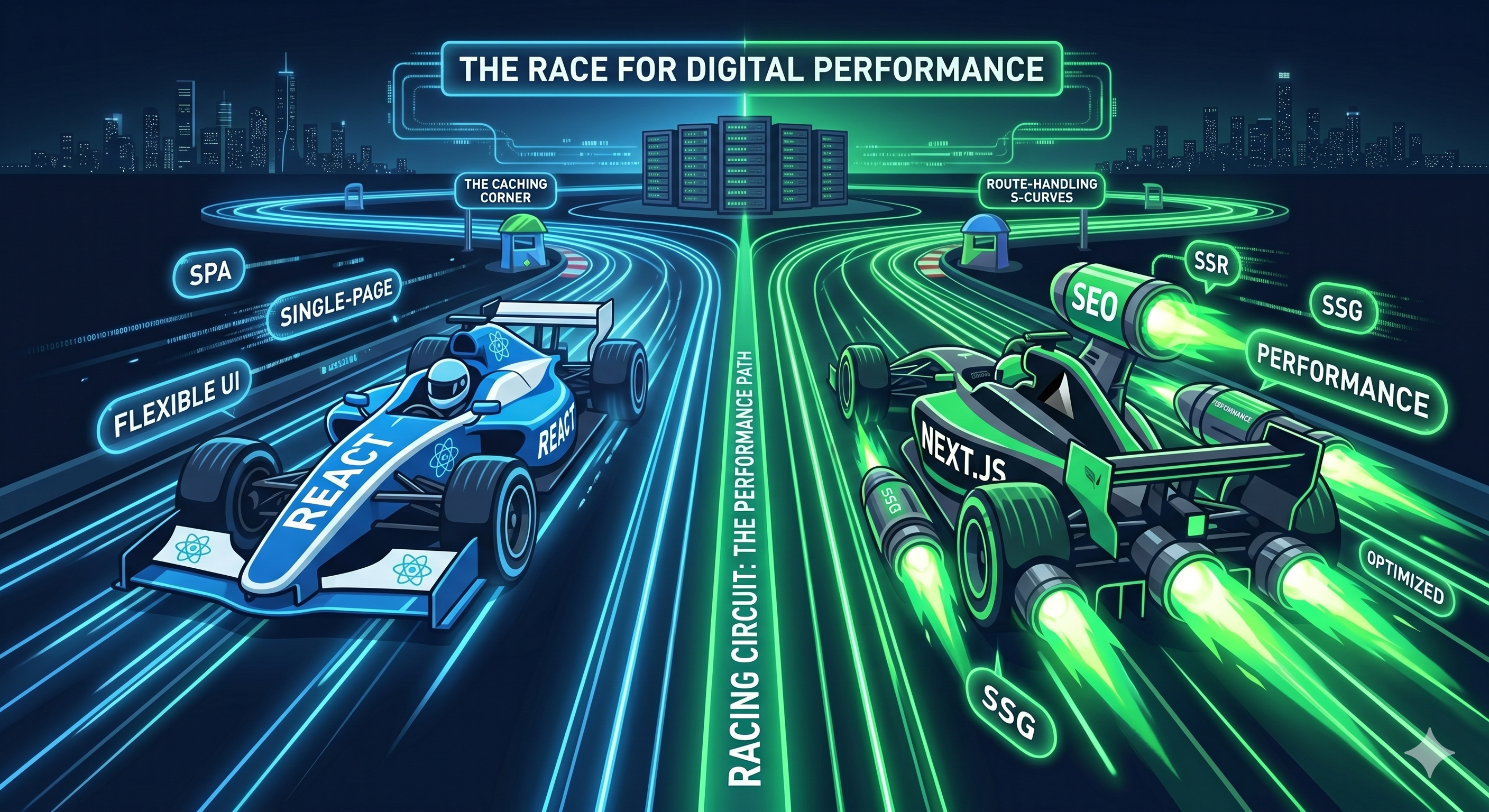
The catch with plain React? Performance and SEO. Because plain React apps render entirely in the browser (client-side rendering), search engines may have a harder time indexing your content, and users see a blank screen until the JavaScript loads. For public-facing websites, this is a real problem.

When Next.js Makes Sense
Next.js is almost always the right choice for production web applications. Here's why:
SEO matters to you — Next.js renders pages on the server before sending them to the browser. Search engines get fully rendered HTML, which is much easier to index. If you want to rank on Google, Next.js gives you a significant head start.
You're building a marketing website or blog — Static site generation in Next.js means your pages are pre-built and served instantly, with zero server processing needed per request. Incredibly fast, incredibly SEO-friendly.
You need an API alongside your frontend — Next.js has built-in API routes. You can build your backend endpoints right inside the same project, which simplifies your architecture significantly.
You want better performance by default — Next.js has built-in image optimization, automatic code splitting, and smart prefetching. Your site loads faster out of the box, without you having to configure anything extra.
You're building an e-commerce store — Fast load times, server-rendered product pages, and SEO-optimized URLs are all critical for e-commerce. Next.js is purpose-built for exactly this kind of performance requirement.
You're building at scale — Large teams and large projects benefit from Next.js's structure and conventions. Everyone knows where files go and how things work.
A Quick Comparison
| Feature | Plain React | Next.js |
|---|---|---|
| Rendering | Client-side | Server + Client |
| SEO | Poor | Excellent |
| Routing | Manual setup | File-based (built-in) |
| Performance | Good | Excellent |
| API Routes | No | Yes |
| Image Optimization | Manual | Built-in |
| Learning Curve | Low | Moderate |
| Best For | SPAs, dashboards | Websites, e-commerce, full-stack apps |
What About the Learning Curve?
Plain React is easier to pick up, but Next.js isn't dramatically harder. If you already know React, Next.js builds on top of it — the concepts are familiar, just with extra capabilities layered on.
For most projects at STAKVAX, Next.js is our default choice. It gives us the best foundation for performance, SEO, and scalability without adding unnecessary complexity.
So Which Should You Choose?
Here's a simple way to decide:
If you're building something public-facing — a website, a landing page, a blog, an e-commerce store, a portfolio — use Next.js. Every time.
If you're building something private — a dashboard, an internal tool, a data management app behind a login — plain React is perfectly fine and often the cleaner choice.
If you're not sure, go with Next.js. You'll have more options, better performance, and you won't have to refactor later when your requirements grow.
Our Take
At STAKVAX, we build with Next.js for the vast majority of our projects. The performance benefits, SEO capabilities, and developer experience it provides make it the right default for almost any web application we work on.
The goal is always to give your project the best possible foundation — and in most cases, that foundation is Next.js.
Have a project in mind and not sure which tech stack makes sense? We offer free consultations where we'll talk through your requirements and give you an honest recommendation — no sales pitch attached.